The Malabar Parotta: 36 Layers, One Perfect Bite
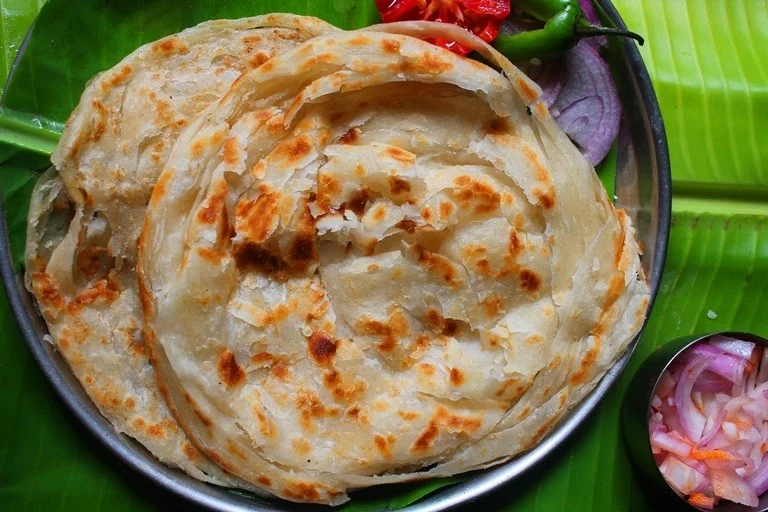
Order a Malabar parotta anywhere from Kannur to Kuwait and the person handing it to you will crush it lightly between their palms before it hits your plate. That small, almost violent gesture is the whole point of the dish: those 30-plus laminated layers are only alive when they've been shocked loose, so the parotta unfurls like a paper accordion the moment you tear it.
The parotta arrived in Kerala with Tamil Muslim migrant workers in the 19th century, but it was on the Malabar coast — in the toddy shops of Kozhikode, Kannur and Thalassery — that it became a signature. Today it's the flatbread you'll find on almost every menu from a highway dhaba to a five-star hotel in Kochi, and it has crossed the Gulf so thoroughly that Dubai's construction canteens serve it by the thousand every morning.
The dough itself is unfussy: maida (refined wheat flour), a pinch of salt, sugar, an egg or a splash of milk, and enough water to bring it together. What makes a parotta a parotta happens after that. The dough rests, then each ball is oiled generously with ghee and stretched — by hand, on a marble slab — until it's almost translucent. That sheet is smeared with more ghee, folded like a fan into a long ribbon, and then coiled into a tight spiral. Only then is the spiral flattened and cooked on a hot tawa until the outer layers crisp and the inner ones stay soft.
When you bite through a good parotta you should feel two textures at once. The crust snaps like a mille-feuille; the middle chews like a fresh naan. If either is missing, the parotta has been rushed. At Café Malabar we rest our dough for a minimum of four hours and lift each parotta by hand before it hits the tawa — you can watch it happen from the dining room.
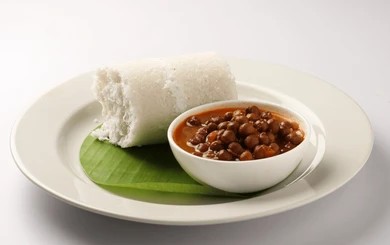
What you eat with it is nearly as important as the bread. In Kerala the classic pairing is Beef Ularthiyathu, dry-fried beef with coconut slivers, curry leaves and cracked black pepper — the parotta acts as an edible spoon for the dark, sticky gravy. Chicken curry with coconut milk is a gentler match, and vegetarians in Malabar routinely tear parotta into a bowl of dal or kadala (black chickpea) curry.
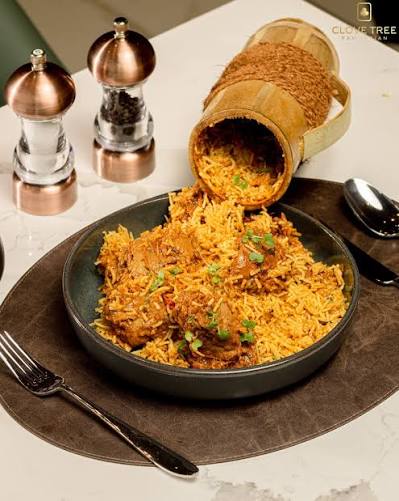
We serve the parotta three ways at 142 Arab Street: as a Kerala Parotta Set with our beef ularthiyathu, as Kothu Parotta (shredded on the tawa with egg, chicken and masala, the way roadside stalls do it after 10 pm), and as a plain accompaniment to any of our biryanis. Whichever you choose, ask for it fresh — the parotta is worth the two-minute wait, and it should never be reheated.
One last piece of etiquette. Never cut a Malabar parotta with a knife. Tear it, always, with your right hand. It's a small ritual, and it turns a piece of bread into something that has to be eaten slowly, layer by layer, exactly the way the cook intended.
Key facts
- Origin
- Kerala Malabar coast, 19th century
- Layers
- 30–40 per parotta
- Flour
- Maida (refined wheat)
- Classic pairing
- Beef ularthiyathu or Kerala chicken curry
Frequently asked
How many layers does a Malabar parotta have?
A well-made Malabar parotta has 30 to 40 distinct layers, created by stretching, ribboning and coiling the dough before rolling.
What's the difference between parotta and paratha?
Paratha is a whole-wheat, less-laminated North Indian flatbread. Malabar parotta is made from refined maida flour and heavily laminated with ghee for a flaky, layered texture.
Is Malabar parotta vegetarian?
The bread itself is vegetarian (sometimes contains egg). It's often paired with beef, chicken or mutton, but is equally good with dal or vegetable curry.
Where can I eat Malabar parotta in Singapore?
Café Malabar at 142 Arab Street serves fresh, hand-slapped Malabar parotta daily, including a kothu parotta for the late-night crowd.
Come taste it
Ready to eat with us?
Explore the full Malabar menu or WhatsApp us to reserve a table at 142 Arab Street.
Or call +65 8133 5071